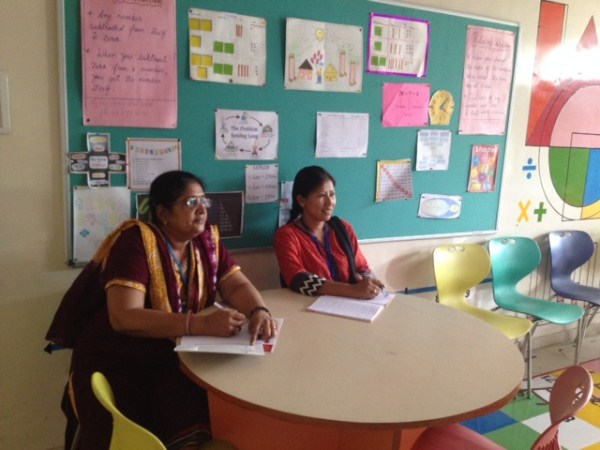
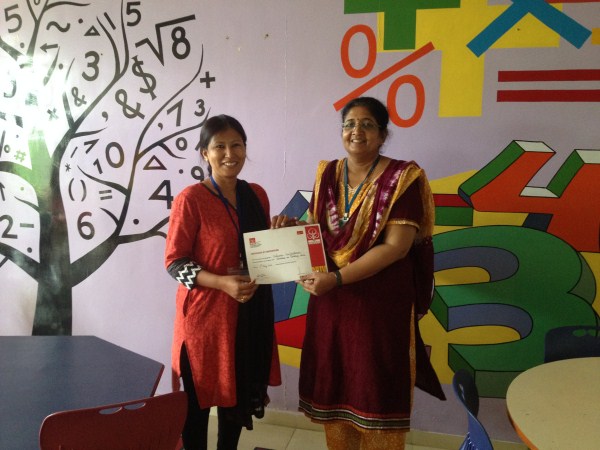
Two English subject teachers from Podar World School, Sherkhi attended a workshop on Debating skills. They were Ms. Kalpana Unnikrishnan and Ms. Durgeshwari Gussein from the Sec & Hr. Sec section to get a better understanding of the skills so as to help learners as and when required while participating in competitions held at the Inter or Intra levels.
There were registrations to the workshop from different districts of Gujarat like Surat, Amreli, Ankleshwar etc. and so the workshop which was to start at 9.30 am started at 10.15 am after the Tea-break. Soon after the ritual of introduction by all the participants (around 25) the workshop started with an opening sentence as to ‘What do we understand by a ‘Debate’? It is basically a form of speech. The Resource person very rightly pointed out that what she gets to hear in the name of debate is a well tailored speech on the content which according to the speaker includes proposition, all arguments and even the closing statement. Learners fail to distinguish between Elocution, Extempore and a Debate.
A debate, a literary skill has 3 components. They are Context, Mechanics and Preparation. There had been a tradition of debates in Indian society and such a debating society present perspectives in a civilized form, debates helped to assume equality and even reduced violences. The book by Amartya Sen, the famous economist, entitled 'The Argumentative India' presents such an image of the Indian society. According to him, people of ancient India used it in their day to day discourses and so this is an ancient literary skill. Mechanics include the motion i.e.Proposition speaker's view points (for) and Opposition speaker's view point (against the motion). It also includes Opening argument, Rebuttal (i.e. identifying weak points in the opponent, presenting facts, examples, logical fallacies to prove the opponent’s argument is incorrect). The Argument stage is a persuasive stage which either leads to agreement or disagreement based on the supporting data, facts, source, analogy, humor, wit etc.
To add appeal to the audience/Judge, the debator can add Logos (using logical argument, as in the speech of Brutus in ‘Julius Caesar’) Pathos (creating an emotional reaction, as in the speech of Antony in Julius Caesar) and Ethos (projecting a trustworthy, authoritative or charismatic image). Finally the stage of Preparation depends upon the effectiveness of all the above components. Certain points to be remembered by debators are: To quote from recent resources and to go for recent statistics. A debator should never use personal pronouns such as 'I, I don't think, I believe etc... besides logical fallacy need not be entertained. In the closing argument, summarize the proposition speaker's argument, draw ideas from rebuttal round and finally state the position very firmly like ‘So eventually one could conclude that...'
There was a lunch break of 30 minutes and around 1.00 pm after the break, the Resource person talked about the Formats of Debates found in and around the world. They are'British Parliamentary Debate, Oxford style Debate, Mace Debate, Asian Universities Debating Championship Largely Australian Format,World Karl Popper Debate, Paris style Debating, Canadian Parliamentary Debate etc. While preparing it is required of the debator to do extensive research, to develop an organic understanding irrespective of the position (for or against), anticipate the evidences the opponent may present and the questions that the judge may ask and thus prepare the content. The marking criteria for debate should be 'Quality of argument, Skill of rebuttal, and Closing argument’
Thanks to the Management and to the Principal, Ms. Preeta Pillai for availing such an opportunity, as Debating skills seems to be the only problem solver for a plethora of issues of National or International importance which could be conducted in the true spirit of transparency through the skills.